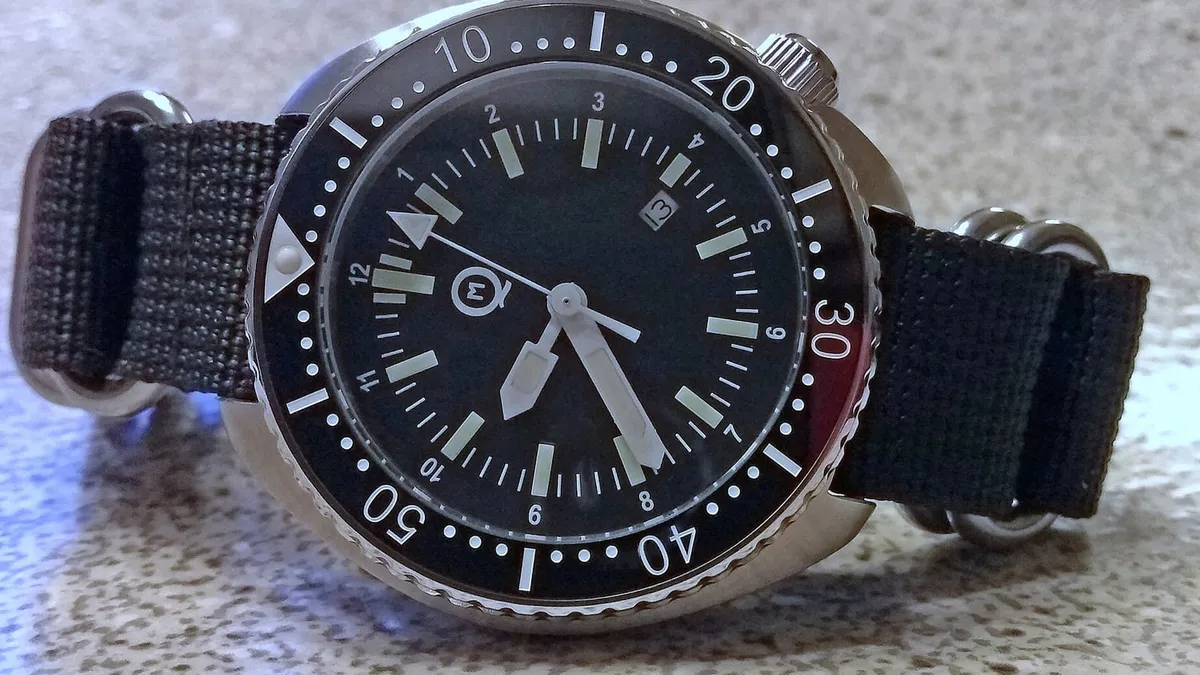
A watch marked 50 metres will survive a swim in most buyers’ estimation, and that estimation sits behind a large share of water damage claims. The depth figure on a caseback is not a depth at which the watch keeps working. It is a laboratory result on a dry, new sample, converted into metres because metres print more easily than bars. Read as a promise about depth, the number overstates the watch. Read as a pressure at which a new seal held once, in a tank, it is accurate, and it is worth having.
The distance between those two readings comes from three things: the test is static, the sample is new, and the part that keeps water out is a consumable. No higher number on the back removes any of them.
What the depth figure actually measures
The consumer standard behind most ratings is ISO 22810, which sets out how a water resistant watch is tested and marked. A sample is placed in a pressure vessel and held at an overpressure for a set time, then inspected for the ingress of water and, in one variant, for condensation forming under a heated crystal. The figure on the caseback restates that test pressure in metres of water, using the rough equivalence of one bar to a ten metre column of still water.
The arithmetic is worth being plain about. One bar is 100 kilopascals, close enough to the pressure of ten metres of still water. A watch marked 5 bar, 50 metres or 50 m has met the same test pressure, and the three markings are different ways of saying one thing. A watch marked 3 ATM has been tested at 3 bar rather than at half the pressure of a 6 ATM watch, because ATM and bar are the same unit expressed in two notations.
What the number does not record is how the pressure was applied. In a tank it rises smoothly over seconds and then stays level. Nothing in the test mimics an arm striking the surface of a pool.
Static pressure against a moving wrist
Pressure at a seal is the sum of a static term and a dynamic one. The static term is simple: the deeper the watch, the greater the pressure, at roughly one bar for every ten metres. The dynamic term depends on movement, and it is the term the tank cannot reproduce.
An arm entering water at speed produces a momentary pressure at the seal that is higher than the hydrostatic figure for the same depth. The spike lasts a fraction of a second and is greatest where the watch first meets the water, which on a swimming stroke is usually the crown side. A jumping entry, a dive from a board or a fast hand entry into a lake all produce peaks well above the depth rating for an instant. That does not make every swimming watch a liability, but it does mean the margin between the printed number and the water is what the buyer is actually relying on.
The same reasoning applies to a shower, where depth is not the issue at all. Hot water and soap act on the gasket material, and a jet directed at the crown is a concentrated pressure rather than a uniform one.
Why 50 metres is not a swimming rating
Watchmakers have settled on a set of practical readings that sit below the literal figure. The table below is the version most of them will give when asked directly.
| Marking | Test pressure | What it tolerates in practice |
|---|---|---|
| 3 bar / 30 m | 3 bar | Rain, hand washing, splashes at a sink |
| 5 bar / 50 m | 5 bar | Brief accidental immersion, not swimming |
| 10 bar / 100 m | 10 bar | Swimming and snorkelling, crown secured |
| 20 bar / 200 m | 20 bar | Diving at recreational depths |
The reason 50 metres is not a swimming rating follows from the two sections above. A rating of 5 bar covers the static pressure at five metres, which no swimmer holds for long, but it leaves little room for the dynamic peaks of a stroke and none at all for a gasket that has stiffened with age.
The parts that keep the water out
Water resistance is a property of several small components, not of the case metal.
- Caseback gasket. An elastomer ring compressed between case and back. A screw-down back compresses it evenly. A snap-back relies on the fit of the case lip and is harder to reseal reliably once opened.
- Crown gasket. One or more rings inside the crown, bearing against the tube. A screw-down crown adds a threaded joint that holds the gasket under steady compression, which is why diving watches use one.
- Crystal gasket. The ring between crystal and case, often the first to fail after a crystal replacement carried out without a new gasket.
- Pusher gaskets. Chronograph pushers carry their own seals. On many movements the pushers are not designed for use underwater, and the manual will say so.
- The case itself. Monobloc or well-sealed two-piece cases leak at joints and threads rather than through solid metal.
A watch can also fail at a joint that was never rated: a display back, a valve left loose, or a crown cross-threaded during a service and no longer sealing.
A rating describes new seals
The elastomers doing the sealing are rubber or a synthetic equivalent, and they change with time. Heat, soap, chlorine, sunscreen and repeated compression all act on them. Over years a gasket hardens, takes a compression set and loses the elasticity that made it seal. A dive watch from the 1990s may be a perfectly sound object and still let water past in a sink, because the number on the back described the seals it had when it left the factory.
Service history matters here. A watch opened for regulation, a battery change or a crystal swap should have had the caseback gasket replaced, and a careful watchmaker will pressure test it afterwards. A watch with no record and an unknown history should be treated as unresistant until it has been tested.
How to decide before trusting a number
Match the rating to the hardest thing the watch will meet, then add one step of margin. A watch worn swimming should be rated to 100 metres or more. A watch that sees only rain and hand washing is fine at 30 metres. For anything vintage, anything with an unknown service history, or anything about to go near water deliberately, have a watchmaker run a pressure test first. It is a short procedure and the result is worth more than the caseback.
The printed depth is a starting point and a way of comparing one watch with another. It is not a forecast about the next swim.