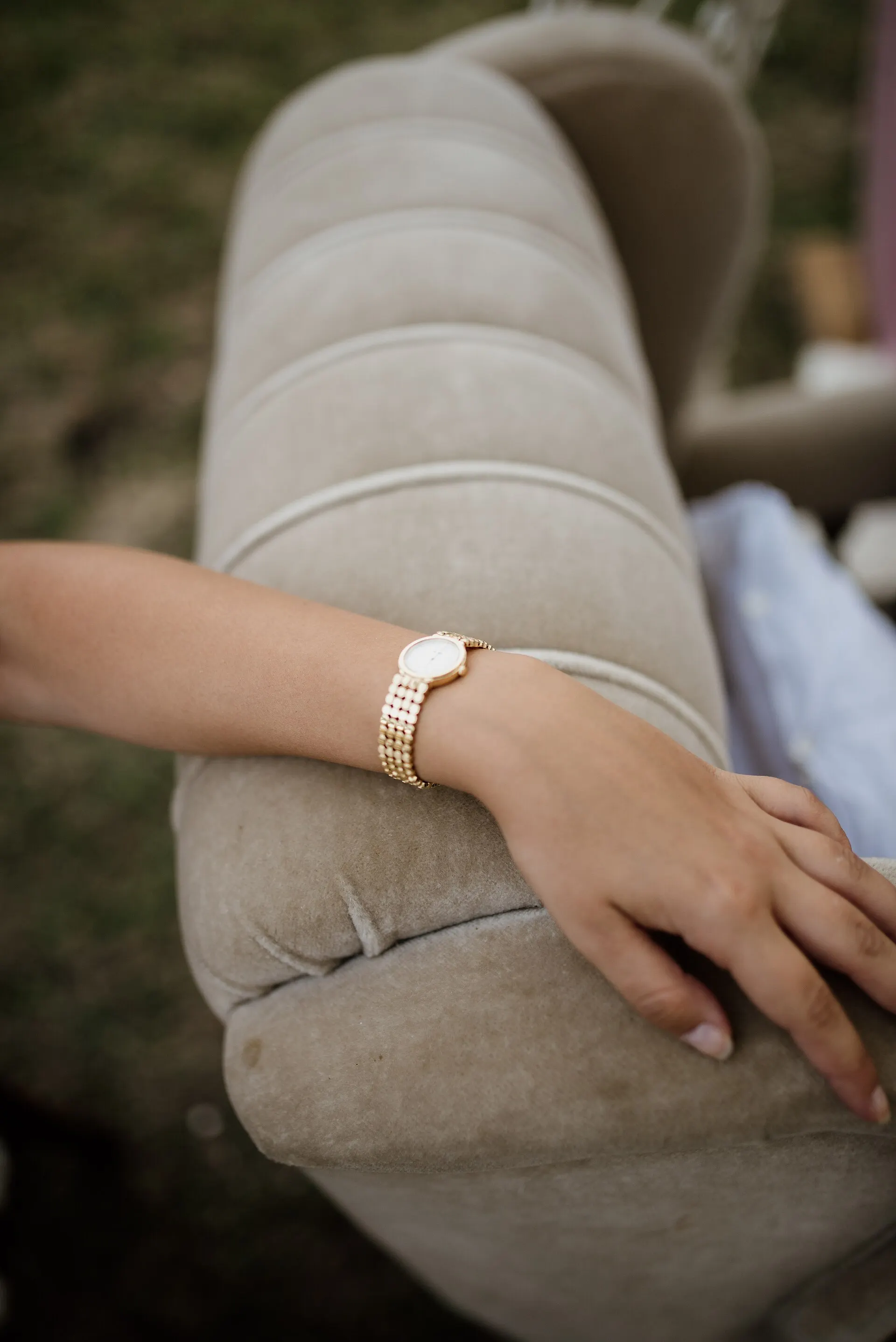
The women’s watch market is full of beautiful objects that are hard to judge from a spec sheet. A case may be 28, 34 or 38 mm, carry diamonds or none, and run on anything from a disposable battery to a finely finished automatic. None of that settles whether it’s well made, comfortable or worth the price.
Use the approach that works for any watch: proportion first, then construction, movement and serviceability. Size is only the start.
Proportion isn’t the same as small
A compact watch can still wear badly. What matters is what eye and wrist experience together.
Lug-to-lug usually matters more than diameter. It measures end to end and decides whether the case sits on the flat top of the wrist or overhangs. A 34 mm watch with long, straight lugs can cover more wrist than a curved 36 mm one.
Case shape changes the reading. Cushion, rectangular and tonneau cases carry visual weight differently from round ones. A rectangular watch with a modest width may run longer along the arm. Judge the whole silhouette.
Thickness decides how it behaves under a sleeve and whether it feels top-heavy. Under roughly 10 mm, most watches vanish under a tailored cuff. Over 12 mm, the case starts announcing itself, especially with a domed caseback.
Dial opening and bezel set perceived size. A narrow bezel and pale dial make a case look bigger; a broad bezel, dark dial and tight markers make it look contained. That’s why two 34 mm watches can look millimeters apart.
Movement: what you’re paying for
Quartz is accurate, convenient and relatively cheap to replace. In a fashion-led watch it’s often the sensible choice. Look for a named caliber with a service route, not an unmarked module a local watchmaker can’t source. Servicing is cheaper too: Omega quartz service runs about $350–$450 at Omega or $150–$300 independent, versus $850–$1,200 official for its automatics, per watchscanning.com, Oct 2026.
Mechanical adds winding, a sweeping seconds hand and, in good examples, visible finishing, plus those service costs. Ask whether it’s automatic or hand-wound, how long the power reserve runs, and whether the maker services it after warranty.
Apply the same test to complications. A date is useful; a moonphase, chronograph or open-worked dial can be delightful, but each adds parts and upkeep. Buy the function you’ll use.
Metals, plating and finish
Stainless steel is still the most practical case. It handles daily wear, can be refinished conservatively and doesn’t rely on a thin layer to look right.
Gold plating and PVD look convincing new, but the color shifts as the surface wears, usually first at the caseback, crown and clasp. Solid gold can be polished and repaired, but it’s softer, heavier and far pricier. Neither is automatically better; the question is whether the price reflects what’s underneath.
Look closely at transitions between polished and brushed surfaces. Sharp, consistent edges suggest care; softened edges on a used watch suggest repeated polishing and lost metal. Judge diamonds by setting quality as well as sparkle: even claws, secure stones and clean finishing matter more than total carats.
Bracelets and straps decide comfort
An integrated bracelet can make a small watch feel substantial but limits strap changes. Check that the first links articulate freely and the clasp closes securely. A bracelet tapering to the clasp usually balances better on a smaller wrist than one that stays wide.
Judge leather straps by lining, stitching and attachment. Quick-release spring bars make swaps easy; standard bars widen the choice. A strap too thick for the case overwhelms it; too thin makes a heavier watch feel unstable.
Lug width matters if you want to change the watch’s character. Common widths like 16, 18 or 20 mm open far more options than a proprietary fitting.
The practical checks
On the wrist, before buying:
- The lugs stay on the flat top of the wrist.
- The case doesn’t rotate or lift when the hand moves.
- The crown doesn’t dig into the back of the hand.
- The clasp sits flat and doesn’t catch hair or clothing.
- The dial reads clearly in ordinary indoor light.
- It can be serviced where you live.
- Its water resistance suits how you’ll wear it.
A dress watch rated 30 m is fine for rain and hand washing but isn’t a swimming watch. For regular water exposure, start with a screw-down crown, 100 m or more and intact gaskets.
Buy for the wrist you have
The best women’s watch doesn’t follow a size rule or shrink a men’s model. Its proportions suit the wrist, its construction justifies the price and its running costs are understood before purchase. A watch that fits gets worn, and that’s what turns a luxury object from a display piece into part of daily life.