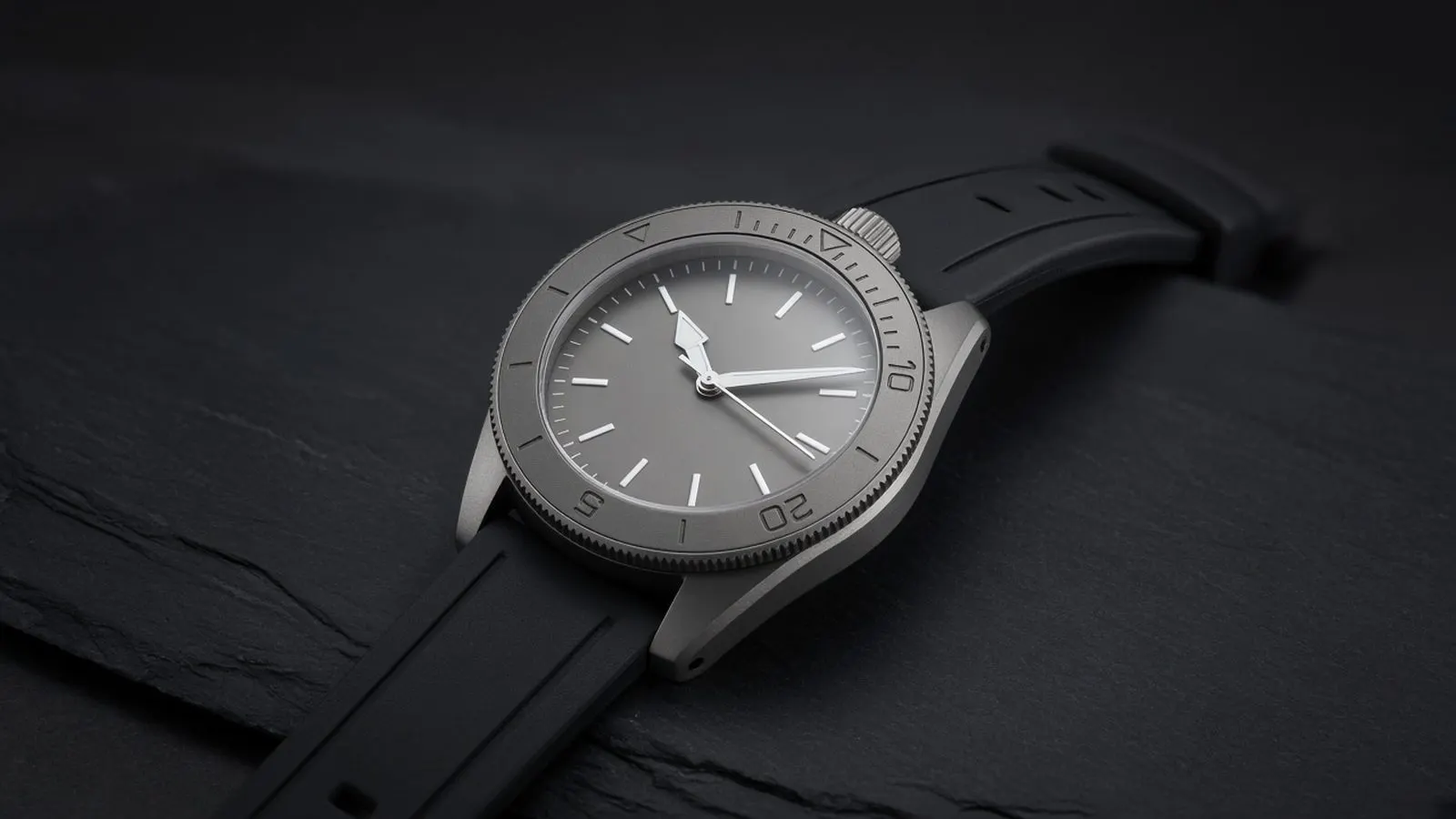
$2,750. That’s what Marathon is asking for its 41mm Titanium GSAR Diver’s Automatic Type II, according to Gear Patrol’s October 18, 2026, roundup of watches you might have missed. It’s the first regular-production titanium case for the GSAR, the mil-spec diver Marathon developed for the Canadian government.
The headline number Marathon wants you to remember is 30. The titanium case weighs 30 percent less than the stainless steel version. The number I’d want you to remember is a bit less flattering, and we’ll get to it.
The ledger on one watch
Here’s what the spec sheet says, per Gear Patrol:
- Case: 41mm, TAA-compliant grade 5 titanium
- Weight: 30 percent lighter than the steel GSAR
- Strength: roughly twice the tensile strength of the steel case
- Water resistance: 300m
- Movement: Sellita SW200-2 Top Grade, Incabloc shock protection, 65-hour power reserve
- Lume: tritium gas tubes with MaraGlo
- Price: $2,750 at Marathon
TAA-compliant means the material meets the sourcing rules of the US Trade Agreements Act, which governs what the federal government can buy. For a civilian buyer, it’s a provenance note more than a performance one. It tells you something about where the metal came from. It doesn’t make the case any tougher on your wrist.
The movement line is worth a second look. A 65-hour reserve is roughly two days and seventeen hours, which means a watch taken off Friday evening should still be running Monday morning. That’s the kind of spec that changes daily ownership. A lighter case is nice. A watch that survives the weekend in a drawer is nicer.
Tritium tubes glow without charging. They also dim over the years as the tritium decays, which matters on a watch you plan to keep for decades.
Why titanium on a tool watch
Weight is the real argument. A 41mm diver with a 300m rating needs a thick case, and steel at that thickness gets heavy, especially on a bracelet. Titanium lets the watch sit flatter and move less on the wrist. If you’ve ever had a steel diver slide around to the inside of your wrist on a run, you’ll understand the appeal without a single number.
Gear Patrol’s same roundup shows titanium appearing at very different price points. The IWC Pilot’s Watch Performance Chronograph 41 “Year of the Goat,” a limited zodiac edition, uses a 41mm titanium case with IWC’s in-house Calibre 69385 automatic and a 46-hour reserve, at $13,100. The Aether and Bamford D-300 takes a different route entirely: a ceramic case and bezel, with titanium used for the caseback, crown and core, 300m of water resistance, at $2,950.
Line those up and something stands out. The $2,750 Marathon has a longer power reserve than the $13,100 IWC. You’re paying IWC for the chronograph, the in-house calibre and the limited edition, not for the titanium. Titanium itself stopped being exotic a while ago.
The number nobody puts in the press release
Titanium scratches. More visibly than most people expect.
It’s a common complaint among owners, and it surprises buyers because titanium is sold on strength. Strength and surface hardness aren’t the same property. Grade 5 is a strong alloy, but a brushed or bead-blasted titanium case still picks up marks from a desk edge or a door frame, and those marks often show as bright lines against the matte gray. Some brands apply hardening treatments to titanium; check whether the watch you’re buying has one, because the product page will usually say so if it does.
The other half of the story is refinishing. Steel can be brushed and polished back to near-new by most competent watchmakers. Titanium can be refinished too, but the finish is harder to match, and fewer shops will promise an invisible result. Before you buy, ask the dealer or brand who services and refinishes their titanium cases, and what they charge. If they can’t answer, assume the scratches are permanent.
What a buyer should weigh
My math on this one runs like this.
If you’ll actually wear the watch for diving, swimming or outdoor work, titanium’s weight saving is a daily benefit, and the scratches become part of a tool’s life. The Marathon makes a lot of sense here. Heavy use is the point of a GSAR.
If the watch is going into a rotation and you care about how it looks in five years, steel is the cheaper case to keep nice. You’ll spend less at the polishing bench, and resale buyers tend to discount visible wear harshly.
The mistake I’d steer around is paying a large premium for “titanium” on its own. Look at what else the price buys: the movement, the power reserve, the lume and the finishing. At $2,750 the Marathon’s ledger reads well, because the titanium comes with a long reserve and tritium. A titanium case on a basic movement at a higher price is a different proposition.
For more on how different metals age, see our piece on case and bracelet materials. If you’re weighing what it’ll cost to keep any automatic running, our servicing intervals and costs ledger is the next thing to read.